COMMENTARY: Just don’t look: Louie Theroux, the manosphere, and the case for not feeding the beast
A 30-year-old lesson learned from The Simpsons is vital today

The Point welcomes all views and opinions, so long as they are grounded in fact and civil in nature. Comments that drive debate are appreciated and encouraged. Interested in having an op-ed or book review published? Submissions are welcome, and there are paid opportunities for original reporting. Inquire for more information.
By Christopher Flowers
I recently watched the documentary Louis Theroux: Inside the Manosphere on Netflix. Before we get into my thoughts, let’s first define what we are discussing.
UN Women, the lead United Nations entity on gender equality, defines the “manosphere” as a “loose network of communities that claim to address men’s struggles – dating, fitness or fatherhood, for example – but often promote harmful advice and attitudes.”
They elaborate further, and the entire report is worth checking out:
The manosphere is an umbrella term for online communities that have increasingly promoted narrow and aggressive definitions of what it means to be a man – and the false narrative that feminism and gender equality have come at the cost of men’s rights. These communities promote the idea that emotional control, material wealth, physical appearance and dominance, especially over women, are markers of male worth.
The manosphere targets male audiences on social media, podcasts, gamer communities, dating apps and just about all digital spaces. Many participants engage with it while searching for forums to openly discuss or learn about men’s issues. But while content may appear focused on men’s self-improvement, many of these groups promote unhealthy behaviours, like instructing boys and men to build themselves up by putting others down.
Theroux is the clinician of curiosity; he is the interviewer who made My Scientology Movie and a string of BBC investigations essential viewing. Critics have described this new film as clear-eyed and timely, praising Theroux’s patient extraction of the small, revealing moments that expose larger cultural rot. The director’s tactic — stay quiet, let the subject perform, let the camera take over — works again here. As a wrestling fan, I appreciated that Theroux has actually gone into that world before: he made a piece examining the old WCW Power Plant training school and experienced its toughness firsthand. He understands the choreography of forced aggression; the rehearsed machismo, and he follows that lineage of performance without moralizing. The result is exposure of the “what” more than a tidy explanation of the “why.”
The film lays bare how figures like Andrew Tate and a host of imitators manufacture authority out of insecurity; packaging basic cruelty as tough‑love wisdom and monetizing outrage. These aren’t leaders so much as performers in cheap armor — loud, brittle, and often pathetically insecure. Theroux’s scenes of content creators manufacturing cringe felt painfully staged: men hyping themselves to an audience, posturing in front of cameras for maximum outrage. Podcast puffery and social media synergy build them up, but the substance falls apart under the lightest interrogation. Theroux’s camera captures that collapsing façade: the posturing, the amateurish production values, the self‑serious rhetoric that looks humiliating in stillness. The disgust many viewers feel is valid; the paradox is that scrutiny can also feed the systems that reward them, and some of the criticism of Theroux is that he has helped these unsavory characters grow their audiences.
Adolescence, also on Netflix, serves as a sobering complement. It is powerful, one whose arrival, the Guardian wrote, “could hardly be more timely.” Per the article, the show debuted around the same time “as it emerged that crossbow killer Kyle Clifford had searched online for misogynistic podcasts and watched Andrew Tate videos hours before murdering three female members of the Hunt family. Then again, such stories hit headlines with depressing regularity. Perhaps Adolescence would have felt unnervingly on-the-nose whenever it launched.”
Theroux shows us how fake it all is, but what about the impressionable kids who can’t see past the pageantry? Reviewers of Adolescence called it disturbing and necessary, praising its unflinching observational style. Critics noted how the series doesn’t explain everything; rather, it catalogs behavior, patterns, and the quiet ways the manosphere shapes identity.
Both films make visible what usually hides behind noise. Theroux’s documentary is essential because it exposes the performative scaffolding of online culture. Adolescence is essential because it shows the receivers — young people learning manners of performance and aggression. Together they don’t answer the “why” comprehensively, but they make the “what” impossible to ignore.
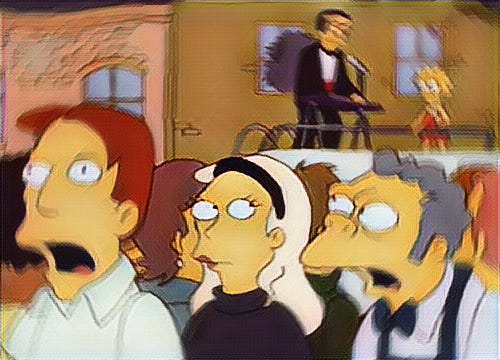
That paradox is where The Simpsons becomes an unexpectedly sharp analogue. The yearly Halloween specials traditionally consist of self-contained, non-canonical segments; playful, often darker riffs where writers experiment and satire runs wild. Season seven’s spooky samplings include “Attack of the 50-Foot Eyesores,” a spoof of television gluttony and ad‑driven spectacle that urges simple abstention as a cure. A magical(?) lightning strike brings images on billboards and signs to life. To save the town, Lisa must spread the message through the catchy sounds of one of Canada’s top-selling artists.
“To stop those monsters — 1, 2, 3, — here’s a fresh new way that’s trouble-free; it’s got Paul Anka’s guarantee…” And, as we all know, that guarantee is (for some reason) void in Tennessee. But, the point remains:
Just don’t look.
They engage in “viral content” aka being loud, obnoxious, sexist, racist… assholes. And that’s the nicest way I can put it. We have to stop giving them likes, hearts, emojis, clicks, and any other telephone functions that have been monetized. The message of the song — resist overconsumption of capitalist spectacle — applies neatly to the manosphere. Where the 1990s gave us trashy shock radio and the 2000s offered up cable television blowhards, today’s ecology amplifies that content into constant, targeted feeds. The difference is scope and feedback: algorithms teach creators what provokes, and monetary incentives harden cringe into industry. The Simpsons anticipated this dynamic in miniature: spectacle preys on attention, and refusal is the simplest countermeasure. Sometimes the most radical act is small and boring — go touch grass, as they say.
Documentaries like these matter because they illuminate, and that attention can be conscientious or compulsive. The moral here is depressingly simple in theory, but hard to police in the void that is social media: don’t glamorize the spectacle by amplifying it. Sometimes the most effective resistance is refusal — mute the mic, close the tab, and don’t feed the machinery that turns insecurity into industry. Just don’t look.