Pittsburgh's comprehensive plan: Phase 5 explainer
The comprehensive plan went through four phases and is currently in the fifth

By Christopher Flowers
We have come to the final explainer for Pittsburgh’s comprehensive plan. This entry will examine phase 5, Plans development.
Pittsburgh’s comprehensive plan sets goals for the next 25 years — ones the city hopes will revitalize neighborhoods and increase business opportunities.
The comprehensive plan went through four phases and is currently in the fifth:
Research (Phase 1 explainer)
Synthesis (Phase 2 explainer)
Shared vision (Phase 3 explainer)
Scenario planning (Phase 4 explainer)
Plans development
Pittsburgh’s online comprehensive plan hub says the goal is to express “a holistic, community-wide vision of the city’s future” that guides “how the city grows and makes improvements by developing goals and policies related to a range of land use, city services, and quality of life topics.”
Before we get into the fifth and final phase, Plans development, let’s first take a look at…
How we got here
Pittsburgh has allocated $6 million to the comprehensive plan, and the Heinz Endowments donated $750,000. The city’s planning director was quoted in Pittsburgh’s Public Source as saying the plan grew in size, and “will address more than what the state mandates, which has, in turn, made the process more expensive.”
The links to each individual phase are included at the top ⬆️ and explainers of each are below ⬇️
Phase 1 began in October 2024 and ended the following January. A list of 20 topic areas was created through Research that “capture conditions and trends in Pittsburgh and help frame how the city has changed over time, where it stands today, and where trends suggest it is heading.”
The 20 topic areas for the first phase of Pittsburgh’s comprehensive plan are Arts & Culture, Climate Action, Digital Equity & Urban Tech, Economic Opportunity, Energy, Environmental Justice, Food, Historic Preservation, Housing, Land Use & Zoning, Mobility, Neighborhoods, Parks & Open Space, Planning & Civic Engagement, Population, Public Health & Safety, Real Estate & Vacancy, Stormwater Management, Urban Design, and Waste.
Those topic areas went through a process known as Synthesis, which began in February 2025 and concluded that June. The 20 topic areas from the Research phase merged into five plan pillars that summarize “the Urgent Transitions that must be addressed in the plan … [and] also begin to identify areas of progress that should be prioritized over the next 25 years.”
The Synthesis pillars are Resilient Infrastructure, Meaningful Economic Opportunity & Mobility, Attainable Neighborhoods of Choice, Thriving Community Culture & Wellbeing, and Empowered & Engaged Pittsburghers.
Phase 3 ran from July through September 2025 and created a Shared vision that reflects “the voices of thousands of Pittsburghers imagining what we are capable of achieving over the next quarter-century, grounded in the very real challenges we face.”
Each of the 10 Shared vision statements begins: “In 2050, Pittsburgh…”:
Welcomes more people while protecting who’s here
Adds diverse housing choices without losing neighborhood identity
Builds the next great industries, as iconic as steel, as green as our hillsides
Makes it easy to get around
Keeps rivers clean, air breathable & hillsides safe
Closes quality of life gaps so all Pittsburghers thrive, not just survive
Lifts up every culture as Pittsburgh pride and identity
Coordinates across sectors, systems, and geographics
Governs with trust, accountability, and vision
Powers a bold future
Scenario planning, phase 4, considers different possibilities for the future. It included three scenarios, labeled A, B, and C, and ran from October 2025 to January 2026. These have “been informed by all of the comprehensive planning work to date,” per the city website. “The scenarios are designed to help us stress test the big ideas and major policy drivers that will shape the direction of Pittsburgh’s growth.”
Scenario A: The Attainable City is one that “prioritizes population growth, accommodated through more housing and increased density as the primary driver of the city’s economy by creating a diverse mix of attainable housing, supporting anti-displacement efforts, and investing in community resources.”
Scenario B: The Prosperous City is a Scenario planning option to create “job and business growth by expanding economic centers while housing and infrastructure follow to connect people to these opportunities.”
Scenario C: The Climate-Ready City imagines a Pittsburgh in 2050 that spent the last 25 years “expanding and upgrading critical infrastructure to prepare for a more resilient future and repair environmental harms in ways that center equity, health, and sustainability.”
Phase 5, Plans development, unlike the other four phases, is “in draft form, and will be further refined for the final plan based on feedback from additional community engagement,” per the Pittsburgh 2050 website. This phase began in February and concludes in August.
The Land Use Change map in the Plans development phase can look overwhelming when handed to you blind. If you see how Pittsburgh arrived at phase 5, it becomes one of those optical illusion paintings that comes into focus.
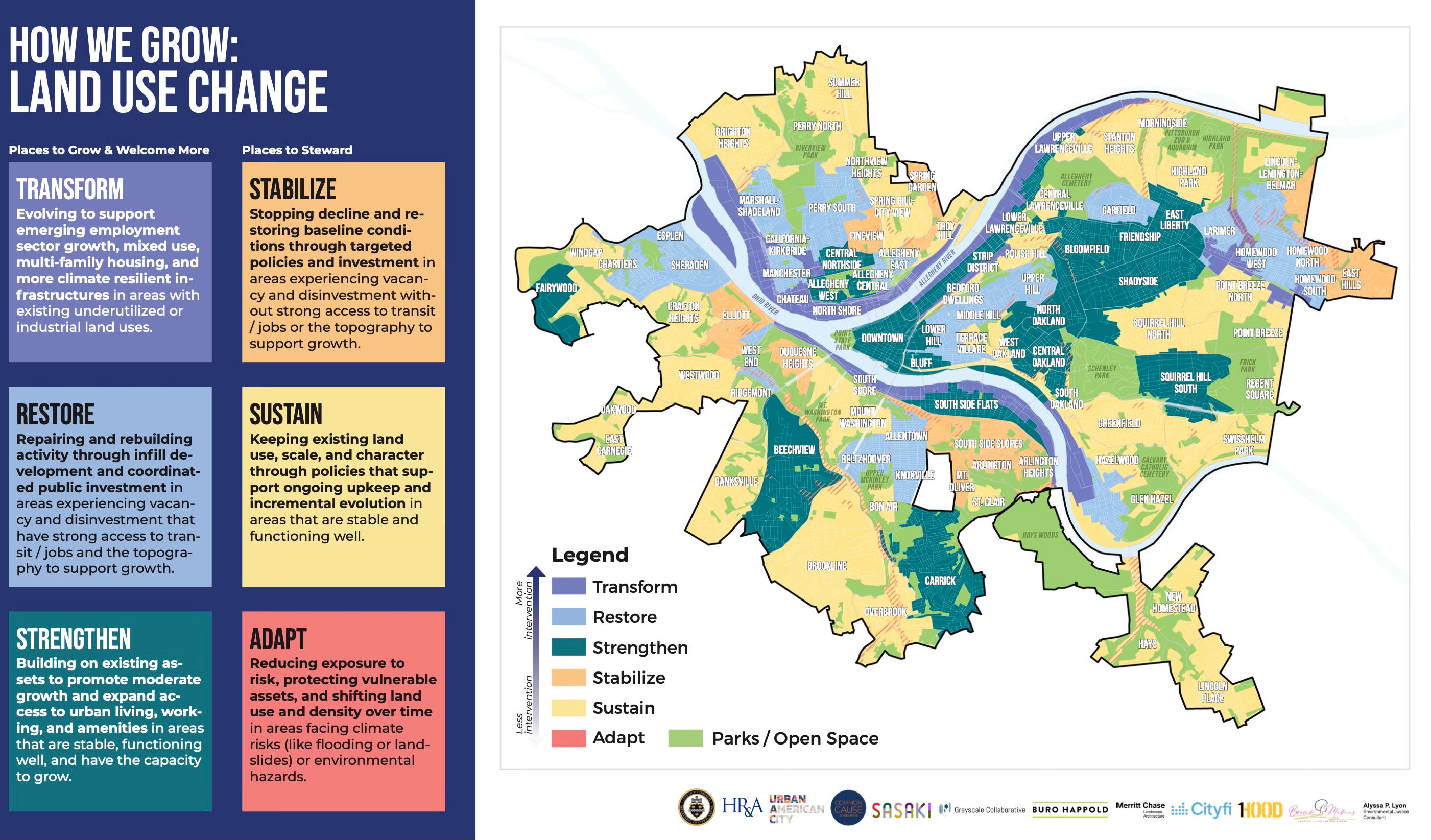
There are two sections in the Plans development Land Use Map, both with three subsections. In the Pittsburgh of 2050, there are Places to Grow & Welcome More, and Places to Steward. Let’s take a look:
Places to Grow & Welcome More
Transform: Evolving to support emerging employment sector growth, mixed use, multi-family housing, and more climate resilient infrastructures in areas with existing underutilized or industrial land uses.
Restore: Repairing and rebuilding activity through infill development and coordinated public investment in areas experiencing vacancy and disinvestment that have strong access to transit/jobs and the topography to support growth.
Strengthen: Building on existing assets to promote moderate growth and expand access to urban living, working, and amenities in areas that are stable, functioning well, and have the capacity to grow.
If you find Shadyside on the map, you’ll see that Pittsburgh wants to strengthen that area. The West End is one the city wants to restore.
Places to Steward
Stabilize: Stopping decline and restoring baseline conditions through targeted policies and investment in areas experiencing vacancy and disinvestment without strong access to transit/jobs or the topography to support growth.
Sustain: Keeping existing land use, scale, and character through policies that support ongoing upkeep and incremental evolution in areas that are stable and functioning well.
Adapt: Reducing exposure to risk, protecting vulnerable assets, and shifting land use and density over time in areas facing climate risks (like flooding or land- slides) or environmental hazards.
The South Side Slopes is an area the city wants to stabilize. There is a lot of yellow, so there are many places where Pittsburgh believes the status quo is working.
Now that you know how the Land Use Change map works, use that knowledge to explore the four remaining maps at the Pittsburgh 2050 website.
The four maps are labeled:
Economy
Housing
Mobility
Resilient Infrastructure
Then the colors of the six subheads are concentrated on those maps. You can see which areas they want to transform for better housing, which business sectors they want to stabilize, how they want to strengthen public transportation (aka Mobility), etc.
In the coming weeks, the city should be announcing public hearings on the finalization of the Plans development maps and the comprehensive plan overall. With phases 1 through 4, I was telling you about things that had already happened. Phase 5 is active and Pittsburgh wants feedback. If you like the comprehensive plan, let your voice be heard. If you don’t like these maps, tell them. Or, tell me, and I’ll tell them. Post your thoughts on social media. Email your council representative. Go to a city council meeting. Tell them, politely, right to their face if you think this plan is garbage.
If you like the way the city is going, use your voice and power at the ballot to keep the status quo. If you see an area on the decline, vote for change. If you are a voting-age citizen of Pittsburgh, you have so much power that you don’t even realize.
. . .